What ‘Turin grissini’ means
The grissino was born in Turin. According to tradition, in 1679 the court baker Antonio Brunero made it, on the advice of the physician Teobaldo Pecchio, for the young Duke Victor Amadeus II, who found bread hard to digest. It's a story handed down rather than documented. That's why people speak of Turin grissini: they are the traditional grissini of Turin and Piedmont.
On the packs, though, ‘grissini torinesi’ (Turin grissini) is often a trade name: in Google's search suggestions it appears mostly next to the names of supermarket brands, and there is no grissino in the EU register of PDOs and PGIs. The name doesn't say how the grissino is made: the list of ingredients does.
The Turin grissino we make is the Rubatà: what the name means and where it comes from is on the page What are Rubatà grissini?.
Updated on 1 November 2026. Written by Grissinificio Feyles; the sources are listed at the end.
The two shapes: rubatà and stirato
Traditional Piedmontese grissini come in two kinds, and they differ in how the dough takes its shape. The rubatà is named after the rolled dough (‘rubatà’ is Piedmontese for ‘rolled’) and is knobbly, irregular and crisp. The stirato is named after the dough being pulled out lengthways, and it comes out thin and even.
Both are on the Italian Ministry of Agriculture's national list of traditional agri-food products (PAT) for Piedmont: ‘Rubatà’ as number 309 and ‘Grissino stirato’ as number 273, in the revision of the list from February 2026. Grissinificio Feyles makes the Rubatà; we don't make the stirato.
To read a grissino's label and choose the right one for each occasion, see our guide How to choose grissini.
What goes into a Turin grissino
Our Rubatà grissini contain flour, malted wheat flour, sea salt and yeast; then the fat changes, lard in Il Classico and olive or sunflower oil in almost all the others, plus the ingredients each flavour is named after. Below are the eight flavours with the dough as stated on the label and the energy per 100 g; each name leads to the product page, with the full list of ingredients, the allergens and the nutrition table.
| Flavour | The dough, from the label | Energy per 100 g |
|---|---|---|
| Il Classico | soft wheat flour type 0 86%, lard 6.8%, malt, sea salt and yeast | 1,626 kJ / 385 kcal |
| L'Extravergine | soft wheat flour type 0 82%, extra virgin olive oil 5.5%, olive oil 5.5%, malt, sea salt and yeast | 1,826 kJ / 434 kcal |
| Il Polentino | soft wheat flour type 0 60%, maize flour 26%, high oleic sunflower oil 5.1%, malt, sea salt and yeast | 1,646 kJ / 390 kcal |
| Il Light | soft wheat flour type 0 92%, malt, sea salt and yeast | 1,502 kJ / 354 kcal |
| L'Integrale | wholemeal wheat flour, soft wheat flour type 0, extra virgin olive oil, malt, sea salt and yeast | 1,679 kJ / 397 kcal |
| I Tre Semi | soft wheat flour type 0, high oleic sunflower oil, sesame, linseed and chia seeds, malt, sea salt and yeast | 1,724 kJ / 410 kcal |
| Lo Speziato | soft wheat flour type 0 80%, high oleic sunflower oil 8.5%, turmeric 2.3%, dried rosemary 2.3%, malt, sea salt and yeast | 1,619 kJ / 384 kcal |
| Lo Speciale | soft wheat flour type 0, water, chopped hazelnuts and hazelnut flour, olive oil, yeast, salt and malt | 1,744 kJ / 422 kcal |
Energy is given in kilocalories, that is calories, and in kilojoules, always per 100 g of product: that way you can compare different grissini, even when the packs weigh different amounts.
Where to buy Turin grissini in Turin
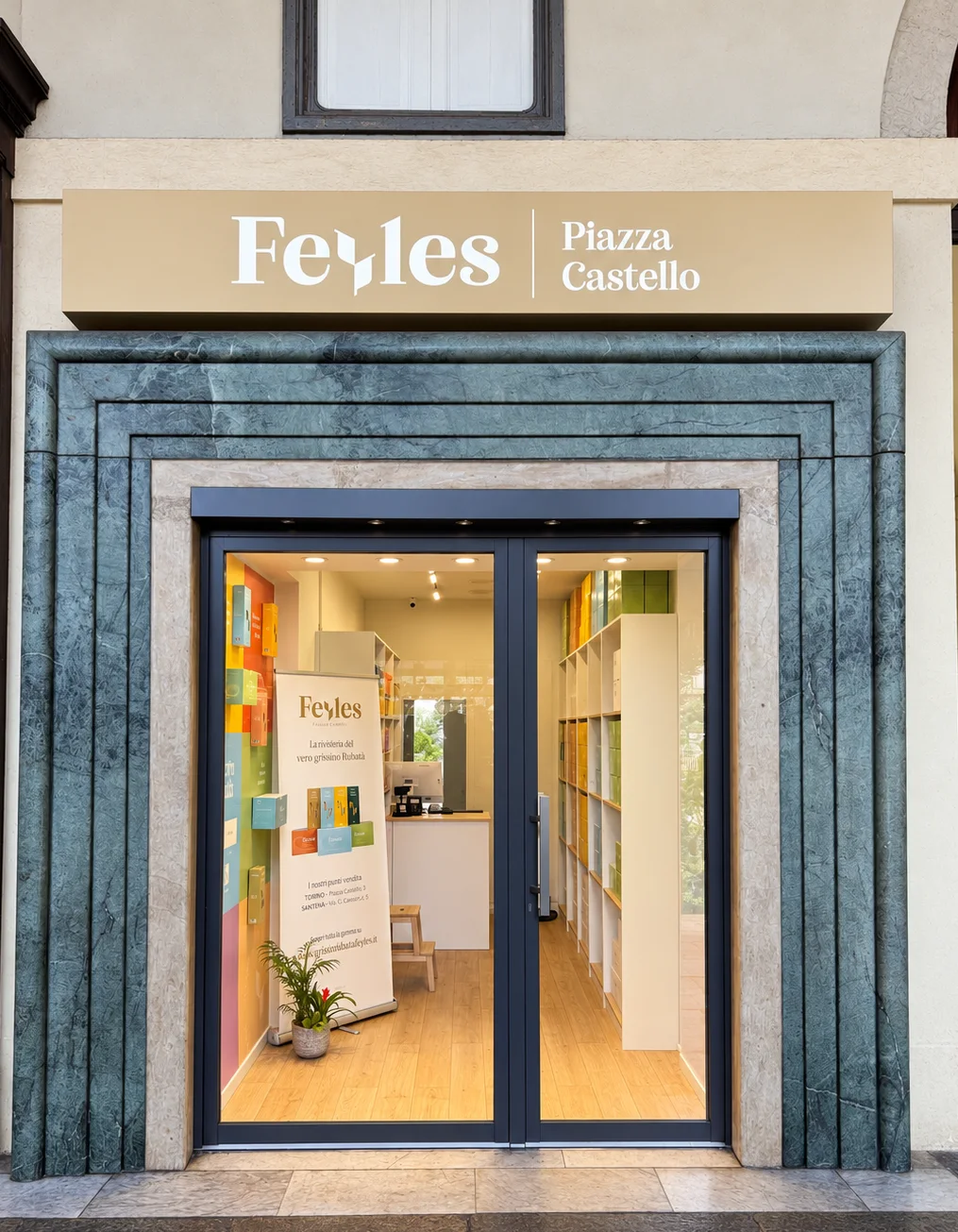
In Turin, Feyles Rubatà grissini are sold in our shop at Piazza Castello 49, under the arcades, a short walk from the Royal Palace: it's open every day 10:00–13:15 and 14:45–19:30. Address, map and FAQs are on the page of our Turin shop.
In Cambiano, just outside Turin, there's the factory shop inside our bakery, at Via Triberti 4, open Monday to Friday 7:00–20:00, Saturday 7:00–19:30, Sunday 8:30–12:30: how to get there is on the page of our Cambiano shop. Opening hours may change on public holidays: give us a call and we'll tell you.
In Turin you'll also find grissini in other bakeries, and we don't rank them here. The newspaper articles that list the Piazza Castello shop among the places to buy grissini in Turin are on our In the press page.
If you're not in Turin
In the online shop you'll find the flavours and sizes we sell, with their prices. We deliver to addresses in Italy only, by GLS courier. Delivery costs €9.99 and is free on orders of €39.00 or more. If you order by 12 noon (Italian time) on a working day, your parcel goes out the same day. For a present from Turin, there's the page Grissini for Christmas.
For restaurants: individually wrapped grissini
For the restaurant bread basket there is L'Extravergine individually wrapped, in 2 kg boxes; Il Classico and Il Light also come in 3 kg boxes of long grissini. Restaurants, delis and shops can ask for the trade price list on our Wholesale page.
The L'Extravergine page, with the individually wrapped size
Questions about Turin grissini
Are Turin grissini stirato or rubatà?
Both: the rubatà and the stirato are the two traditional grissini of Turin and Piedmont, and both are on Italy's national list of traditional agri-food products. The rubatà, whose name means ‘rolled’, is knobbly and irregular; the stirato is pulled out lengthways, thin and even. Grissinificio Feyles makes the Rubatà, in eight flavours.
How many calories are there in a Turin grissino?
On the label, energy is given per 100 g, not per grissino. The eight Rubatà grissini made by Grissinificio Feyles range from 354 to 434 kcal per 100 g, depending on the flavour; the full nutrition table is on each flavour's page.
How long do grissini keep?
Loose grissini keep for up to 4 months, packaged ones for up to 6 and biscuits for up to 3. Store them in a cool, dry place, away from light. This applies to Grissinificio Feyles grissini; every pack also shows its best-before date.
Can you find Turin grissini in supermarkets?
Yes, from other brands: in Google's search suggestions, ‘grissini torinesi’ appears mostly next to the names of supermarket brands. Grissinificio Feyles Rubatà grissini are sold in its two shops, in Turin at Piazza Castello 49 and in Cambiano at Via Triberti 4, and online at grissinificiofeyles.it, with delivery throughout Italy.
Sources
The facts about the types of grissini and their history come from our guide How to choose grissini, which gives all the sources; those about our products come from our labels. The main ones:
- Italian Ministry of Agriculture, Food Sovereignty and Forests (MASAF), 26th revision of the national list of traditional agri-food products, decree of 6 February 2026, in Italian: for Piedmont, no. 273 ‘Grissino stirato’ and no. 309 ‘Rubatà’.
- Piedmont Region, the regional quality-products website, the ‘Rubatà’ entry and the ‘Grissino stirato’ entry of the traditional products, in Italian.
- European Commission, eAmbrosia, the EU geographical indications register: among PDOs and PGIs there is no grissino.